
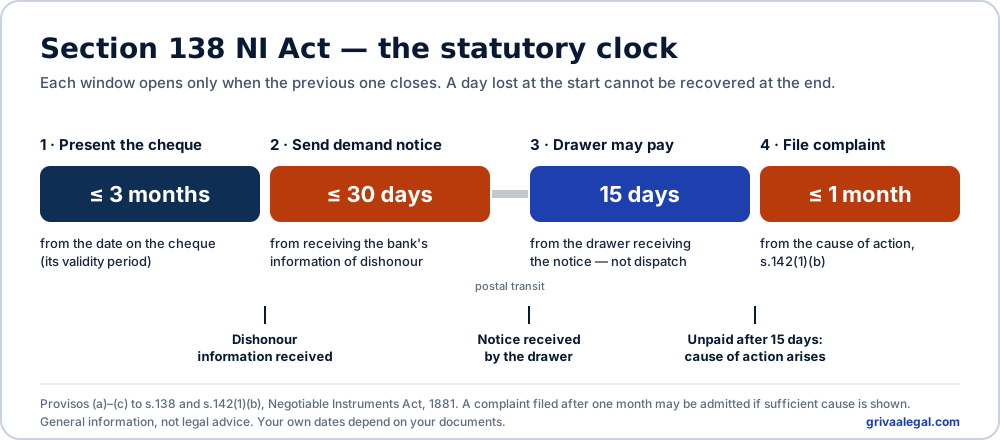
Section 138 of the Negotiable Instruments Act, 1881 makes the dishonour of a cheque for want of funds an offence — but only if the payee follows a fixed sequence of steps, each with its own time limit. People call it the “30-day, 15-day and one-month clock”: 30 days to send a demand notice, 15 days for the drawer to pay, and then one month to file the complaint. Miss a step and the criminal route may close, even where the money is plainly owed.
Step 1: the cheque must be presented while it is valid
Under the Reserve Bank of India's instructions, banks treat a cheque as valid for three months from the date written on it. Proviso (a) to Section 138 requires the cheque to be presented within six months or within its period of validity, whichever is earlier — which, in practice, means within three months.
A post-dated cheque is dated for the future, so its three months run from that future date, not from the day it was handed over. A cheque presented after it has expired is returned as out of date, and that return does not start a Section 138 case.
A cheque can be presented more than once within its validity. The Supreme Court in MSR Leathers v. S. Palaniappan (2013) held that a prosecution can be based on a later dishonour, even if an earlier one was not pursued. The clock described below then runs from the dishonour you actually act on.
Step 2: dishonour and the return memo
When the cheque is returned unpaid — “funds insufficient” or “exceeds arrangement”, and, as courts have held in many cases, reasons such as “account closed” or “payment stopped by drawer” — the bank issues a return memo. Keep the original memo and the returned cheque. They are the foundation of everything that follows.
Step 3: the demand notice within 30 days
Proviso (b) requires the payee to make a written demand for payment within 30 days of receiving information from the bank that the cheque has been returned unpaid. The wording matters: the period runs from when the payee is informed, which is not always the date printed on the memo. If the bank sends the memo a few days later, the date of receipt is the relevant one — but that date has to be provable, so keep the envelope, the email or the bank's SMS.
The safe practice is not to rely on the gap at all. Treat the memo date as the start and send the notice well inside 30 days.
The notice should demand the cheque amount, identify the cheque (number, date, bank, amount) and the reason for return, and be sent to the drawer's correct address. Where the drawer is a company or firm, it is usual to address the notice to the entity and to the persons in charge of its affairs, since Section 141 can make them liable too — who should be named depends on the facts.
Step 4: the drawer's 15 days, and service of notice
Under proviso (c), the drawer has 15 days from receiving the notice to pay. The offence is complete only if the drawer fails to pay within those 15 days.
Drawers often say they never received the notice. The Supreme Court in C.C. Alavi Haji v. Palapetty Muhammed (2007) held that where a notice is sent by registered post to the correct address, service can be presumed under Section 27 of the General Clauses Act, unless the drawer proves otherwise. It also held that a drawer who claims not to have received the notice can pay the amount within 15 days of receiving the court's summons, and a drawer who does not pay cannot rely on non-service.
Returns marked “refused” or “unclaimed” are frequently treated as service, but each case turns on the address used and the postal record. Keep the postal receipt, tracking report and any returned envelope unopened.
Step 5: the cause of action, and one month to file
The cause of action arises on the day after the 15 days expire without payment. Section 142(1)(b) then requires the complaint to be filed within one month of that date. The statute says one month, not 30 days; the difference is usually a day either way, which is one more reason not to file on the last date.
Filing too early is also a problem. In Yogendra Pratap Singh v. Savitri Pandey (2014) the Supreme Court held that a complaint filed before the 15 days have run out is premature and the court cannot take cognizance of it.
If the month is missed, the proviso to Section 142(1)(b) allows the court to take cognizance after that period if the complainant shows sufficient cause for the delay. That is an application the court decides on the reasons given; it is not a formality, and it should not be planned for.
A worked example with sample dates
The dates below are illustrative only. Real cases depend on the actual dates of receipt, which have to be proved.
| Event | Sample date | What it means |
|---|---|---|
| Cheque dated | 1 June 2026 | Valid for three months from this date |
| Cheque presented | 10 July 2026 | Within validity |
| Return memo dated | 12 July 2026 | “Funds insufficient” |
| Payee receives memo from the bank | 15 July 2026 | The 30-day notice window starts |
| Last date to send notice | 14 August 2026 | 30 days from 15 July (safer to send by 11 August, counting from the memo date) |
| Notice actually sent | 25 July 2026 | By registered post and courier to the correct address |
| Notice delivered to drawer | 28 July 2026 | The drawer's 15 days start |
| Drawer's last day to pay | 12 August 2026 | 15 days from 28 July |
| Cause of action arises | 13 August 2026 | No payment received; a complaint filed before this is premature |
| Complaint to be filed | By 12 September 2026 | Within one month; file earlier rather than argue about the last day |
Which court: Section 142(2)
After the 2015 amendment, Section 142(2) fixes territorial jurisdiction. Where the cheque was delivered for collection through an account, the complaint is filed in the court within whose local jurisdiction the branch of the payee's bank where the payee maintains the account is situated. Where the cheque was presented otherwise than through an account, it is the court where the drawer's branch is situated. Filing in the wrong court causes delay and a return of the complaint, so this is checked against the bank records before filing.
After filing: interim compensation and the appeal deposit
Section 143A allows the trial court to order the drawer to pay interim compensation of up to 20% of the cheque amount, in the circumstances the section sets out (for example, where the accused pleads not guilty in a summary or summons trial). The Supreme Court has treated this as a discretionary power rather than an automatic order, so whether it is granted, and how much, depends on the case. If the drawer is later acquitted, the amount is to be repaid with interest.
Section 148 applies where a convicted drawer appeals. The appellate court may order a deposit of at least 20% of the fine or compensation awarded by the trial court, in addition to any interim compensation already paid. Courts have said such a deposit is ordinarily directed, though the appellate court can make an exception for recorded reasons.
When the clock has already run out
If the notice was not sent in time, or the complaint window has passed without a good reason, the Section 138 route may no longer be available on that cheque. The underlying debt does not vanish because a criminal deadline was missed. A civil claim for the money — including, in suitable cases, a summary suit under Order XXXVII of the Code of Civil Procedure — may still be open, subject to its own limitation period. Our money recovery desk covers that route.
If the cheque was given as security rather than as payment, the timeline is the same, but there is an earlier question about whether a debt was actually due when it was presented. That is covered in is a security cheque covered by Section 138?
Have a bounced cheque and a date you are unsure about?
Send the cheque, the return memo and anything you have sent or received since. The desk maps each date to a document, and advocates handle the notice and any filing.
See the Section 138 deskFAQs
How many days do I have to send a cheque bounce notice?
The written demand must be made within 30 days of receiving information from the bank that the cheque was returned unpaid. That date is not always the date printed on the return memo, but it has to be provable, so it is safer to count from the memo date.
When can I file a Section 138 complaint?
Only after the drawer's 15 days from receiving the notice have expired without payment. The complaint must then be filed within one month of that date. A complaint filed before the 15 days run out is premature.
What if the drawer says the notice was never received?
Where a notice is sent by registered post to the correct address, courts can presume it was served unless the drawer proves otherwise. Keep the postal receipt, tracking report and any returned envelope.
Can a complaint be filed after the one-month period?
The court can take cognizance of a late complaint if sufficient cause for the delay is shown. That is decided on the reasons given in each case, so it should not be relied on as a plan.
Related guides
- Is a security cheque covered by Section 138? — the question to answer before the clock even starts, if the cheque was given as security.
- RERA vs Consumer Forum for a builder refund — where a builder's dishonoured cheque sits alongside a property claim.
The desks these connect to: cheque bounce under Section 138 for the notice and complaint, and money recovery and civil dues where the criminal route is not available or not enough.
This guide is general and informational — not legal advice, not a solicitation, and no substitute for professional advice on your facts. Outcomes depend on facts, documents, forum, limitation and applicable law.